Parashat Vayera D’var 5786 – 8 November 2025
(A video of my reading this d’var is linked at the bottom)
Years ago I heard Rabbi Donniel Hartman speak about the Abraham of Genesis 18:16 – 33 versus the Abraham of Genesis 22. Rabbi Donniel taught that our choice of which Abraham speaks to us said a lot about our relationship with God and Judaism. Do we want a patriarch who argues with God to save strangers – to make sure that the Judge of all judges fairly and does not punish the righteous with the wicked – or do we want an Abraham who quietly agrees to take his “only son, the one you love” and offer him up on some mountain cliff to be determined later? Do we want a Judaism that encourages us to foster a habit of standing up – even to God – versus one that models bystanding even in our own lives?
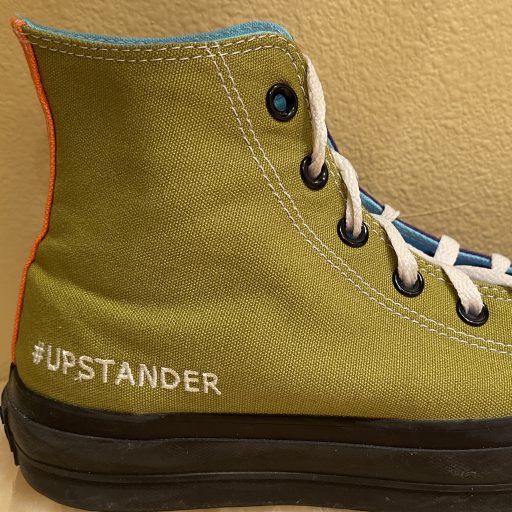
When asked what I do for a living, I will often respond “I make Upstanders.” Not what most people expect for an answer and usually results in a few questions – “what is an Upstander?” and “how do you know?” being most common. I define an Upstander as one who takes action when they see an injustice – who does not stand by and watch others bully, oppress or persecute people, but rather steps in to do something about it – or better, work to prevent it in the first place. I have stories of amazing things my former students have done since leaving my classroom and this anecdotal evidence is impressive, but does not convince those looking for a more evidence based response. I have been privileged to be part of the Mandel Teacher Educator Institute for the past two years and as part of this fellowship was able to do a graduate certificate at HUC in Practitioner Research. The work of this certificate has been researching my own practice as a teacher and my research question came to me quickly – Do I make upstanders or not? And if so, what are the experiences in my classroom that most impact this development?
A Google survey completed by 32 JDS alumni from 2011 – 2025 and six interviews later, the answer is a resounding yes – that the coursework in my classroom, as well as other classes at JDS – does instill in young people a clear understanding of the importance of being an upstander – and now I have 32 definitions of this word and not just my own – as part of my research I had the respondents write their own definitions for the word “Upstander.” This information was very informative and provided a window into how each of these young people thought about being an upstander. Respondents also had an opportunity to respond with details about their learning in Jewish Studies as well as their General Studies classes and these free responses were also very helpful in getting a full picture of what the formative lessons were during their years at JDS and just what went into making an upstander.
As I coded these responses I began to compile a list of the “habits and practices of an Upstander” on a giant post-it note on my wall. I then sorted these into different categories – skills, values, character traits, practices and actions. This work helped me create a graphic that shows the development of a JDS upstander.
I would like to use the traits and the actions of an Upstander – as determined by my research – to discuss these two stories of Abraham and think about what might have helped Abraham in Genesis 22 be more like the Abraham of Genesis 18.
The traits that were named by my former students as essential to being an Upstander are: brave, a leader, questioning, confident, positive, action oriented, grateful, joyous, reflective, and possessing a growth mindset.
Abraham facing God as he is given insight into God’s plans for the home of his nephew Lot and the neighboring town is seen as a leader by God. God shares his plans with Abe because God plans to make Abraham the father of a great nation by whom all the nations of the world will bless themselves. Abraham takes the time allowed by the other two visitors to leave to consider what God has said. He then acts bravely and asks a question of God – “Will you sweep away the innocent along with the guilty?” He is confident that God could not mean to punish the innocent and puts forth a positive vision of saving the city for the sake of the innocent. He challenges God “Shall not the judge of all the earth deal justly?”
Civil discourse is an action that upstanders use and Abraham is trying to have a civil discussion with God, Abraham is giving a voice to the voiceless – he is speaking for the innocents of Sodom and Gomorrah who stand to be wiped off the earth for the sins of their neighbors and he is advocating for change in God’s plan. Abraham is considering all the residents with dignity and he is standing up for what is right. All of these are actions named as those of Upstanders by JDS graduates. Abraham continues to question God – being willing to accept that there might not be 50, 40, 30, even 20 innocents in these towns – and lowers the bar with each increasingly meek request. His bravery in continuing to lower the number with each request and to continue to press God to do the right thing is impressive. Who among us can imagine making such requests of a human leader let alone God!? Abraham reflects on each request, on God’s agreement and is grateful for this agreement – but also knows that the number might need to be lower. His reminding of God that God is the judge of all and should be just reminds God of God’s role and to educate God about what God’s actions look like to the leader he has chosen. He is mindful of the terrible fate awaiting those in Sodom and Gomorrah and acts in a way informed by this perspective.

Abraham in this story also demonstrates many of the skills of an Upstander as found in my coding of my data. He is advocating and using his public speaking skills to confront God. He is thinking critically about what might be acceptable to God – he stops at 10 perhaps sensing God was not willing to go lower. He is making connections for God – reminding God of how God’s actions have lasting consequences and lessons for humans. Values of an Upstander include compassion, empathy, justice, morality, community, respect and gratitude – Abraham demonstrates all of these in his interactions with God in chapter 18. His compassion for those in Sodom and Gomorrah – empathy perhaps for his nephew and his family, his demanding God be just and act morally are clear as are his sense of community with these people. He speaks to God, even as he challenges him, with respect and expresses gratitude when God agrees to each request.
Abraham in this story is a patriarch worth emulating. He is being a role model – a practice of Upstanders – and showing how to stand up to unjust power and to demand that even God acts with morality. He does not go along with God’s plan, he does not just request God spares Lot and his family, he advocates for all the innocents of Sodom and Gomorrah and pushes God to find a reason to not destroy these communities. So what happens between here and the story of Akedat Yitzhak – the binding of Isaac just four short chapters later?
In Chapter 22 God speaks to Abraham and Abraham responds with that word of destiny “Hineini” “Here I am.” This word indicates an openness to what follows and a willingness to be commanded or used for God’s purpose. God then proceeds to command Abraham to take his son “your favored one, Isaac” and to go to Moriah and offer him up as an “oleh” burnt offering on one of the heights there that God will point out later. Now, prior to calling out to Abraham we are told that GOd is putting Abraham to the test. Abe does not know this and I feel that we are left to determine if he passes it or not. I would say that he does not – he certainly fails at being an upstander. Being commanded to offer up your son – a son of your old age that was born after a promise from God that you would finally have a son with your elderly wife, the only son you have now because you already sent the other one away because your wife asked you to – is not a command that anyone should follow unquestioningly – but Abraham does. That questioning and confident leader who was brave and stood up to God is gone. There is no discourse – civil or otherwise – as Abraham silently gets up and starts preparing for the journey. Abraham does not show any compassion or empathy for his wife, whose only son is about to be killed, there is no evidence he even tells her where he is going and midrash says her death in the next parsha is due to her finding out from HaSatan where father and son have gone. There is no reflection on the justice or morality of this request. A wondering when we started doing child sacrifices might have been voiced.
Abraham is action oriented as he gets up early, packs a donkey, and heads off with his son and some servants. Again there is no discussion, only a few words are recorded on day three and those are vague and either hopeful or lies. “God will provide for the sheep” is the response to Isaac wondering where the offering is. In the end, God does indeed provide the ram for the sacrifice and it is God, or the angel, who gives voice to stop Abraham’s blind obedience to God’s command.
Abraham’s lack of curiosity or demand for justice continues when God declares that “For now I know that you fear God, since you have not withheld your son, your favored son, from Me.” I would have been furious. God needed this proof? Abraham has gone through so much at the command of God and has proven his faithfulness over and over. I would have demanded to know why God needed even more proof – and proof gained in such a cruel and unjust manner. I would have asked God about the damage done to my son, the sorrow caused for my wife, my own trauma and guilt at being willing to do this just so God – the all knowing God – could be sure of my faithfulness. We get none of this from Abraham. In one of my favorite Rosh HaShanah books – The White Ram – which I read each year to my middle schoolers – Abraham does question why God needed Abraham to prove his love and faith since God knows all. God responds “Oh, I knew, but I wanted to be sure everyone else knows so that would follow your example.” Follow his example?? This is hardly an Abraham whose example we should follow. Back in the text in the Torah, God makes Abraham some more nice promises and then Abe returns to his servants and heads to Beer-sheba. Next we know Sarah is dead and Isaac never speaks to his father again. Abraham’s days as a role model are over.
My research, and that of other researchers who have set out to figure out what it takes to “create Upstanders” shows that an inspiring role model has an incredible impact on helping young people know that they should take action. In my findings I name this as “The Power of One Significant Story.” In my classroom these role models are Jewish Partisans, RIghteous among the Nations, individuals who show moral courage and create change in the world or save lives, Rabbi Avraham Joshua Heschel who marched in Selma, Jan Karski, Hebrew prophets who spoke out against corruption at the highest levels and others throughout our history who stood up and led rather than allowing history to happen to them. Abraham in Genesis 18 would be a Significant Story. Abraham in chapter 22 would not. Jewish values of v’ahavta re’echa k’mocha – treat your fellow as yourself – the core text of Judaism which teaches love and empathy – as well as “lo taamod al dam re’echa” “do not stand on the blood of your fellow” which means that we should prevent blood from being spilled and act to protect those who are likely to be harmed – are taught in sixth grade in my classroom to provide a values based framework for why it is important to be an upstander. Chapter 18 Abraham demonstrates these values – he is actively working to stop the bloodshed of innocents in Sodom and Gomorrah – Akedat Yitzhak has Abraham ready to spill the blood of his own son.
Remaining engaged and capable – let alone willing – to be an upstander can be exhausting. I know this is very true in our current reality. Compassion fatigue is very real and there is so much going on that we would like to fix, but which we are powerless to really impact. So how does one remain mindful and engaged? The three traits of an Upstander as named by my former students that were most surprising were joyous, grateful and positive – add to this the practice of mindfulness which several of those interviewed gave much credit to for their commitment to doing good in the world. Gratitude for what we have creates a capacity for wanting others to have the same things and reminds us that our work for their rights and well being isn’t leaving us without. Being joyous also gives energy and creates the positivity needed to face situations that feel overwhelming or frightening in order to help others. Mindfulness as a daily practice allows these young people to be aware of what is going on in their worlds and to stay in a mindset that is open to what others are experiencing. It allows them to not be overwhelmed by all that is going on and therefore have more capacity to help. One of my former students, let’s call him Solomon, said that daily mindfulness sessions help him to focus on being his truest self “Solomon Solomon” and his truest self is an Upstander. “Solomon Solomon loves all people and cares and is trying to be empathetic and the best, most righteous Jewish version of myself would be to stand up for the inequities that I see in the world. They also help him monitor his energy and that it is being spent in productive ways that allow him to make an impact. “And not just that upstanding is exhausting. So when are the right times to upstand and what are the times to pick your battles and say today’s not that day?”
One might surmise that being Abraham in his old age, having sent away Hagar and Ishmael, pressured to create a people who will worship God and be a great nation when you have only one son to start with, might have been a lot to deal with. Perhaps Abraham no longer had the joy, positivity and gratitude necessary to have the capacity to stand up to God again. Perhaps his failure to save Sodom and Gomorrah weighed on him and made him less likely to make demands of God? Following the commands of God, who had given him all that he had, might have been how he thought he was to show gratitude – rather than by acting according to the values that God sought to instill in him. To know God should be fair and just in chapter 18 but not demand it in 22 when your own son’s life is at stake, indicates a serious shift in energy and mindset. How might Abraham have been better able to be an upstander for Isaac? How do any of us find the energy to push back against all that is wrong in the world?
Community, gratitude, mindfulness, seeing failure as a stepping stone to success, and having the perspective of history can help us to know what is important and to continue to find the energy to defend it. Finding role models who inspire us, being a role model for others can also give us energy and ideas. Remembering the core values of our traditions as well as the universal values of empathy and compassion keeps us centered. Remembering that all humans are made b’tzelem elohim – in the image of God and are worthy of the same dignity and respect will guide us in our choices and actions. Let us not be like Abraham and sacrifice what is most important to us because we have lost our abilities to be upstanders – let us lean into community, joy and gratitude and remain strong.


