Tag Archives: God

Making Abraham an Upstander

Standard

Parashat Vayera D’var 5786 – 8 November 2025

(A video of my reading this d’var is linked at the bottom)

Years ago I heard Rabbi Donniel Hartman speak about the Abraham of Genesis 18:16 – 33 versus the Abraham of Genesis 22. Rabbi Donniel taught that our choice of which Abraham speaks to us said a lot about our relationship with God and Judaism. Do we want a patriarch who argues with God to save strangers – to make sure that the Judge of all judges fairly and does not punish the righteous with the wicked – or do we want an Abraham who quietly agrees to take his “only son, the one you love” and offer him up on some mountain cliff to be determined later? Do we want a Judaism that encourages us to foster a habit of standing up  – even to God – versus one that models bystanding even in our own lives? 

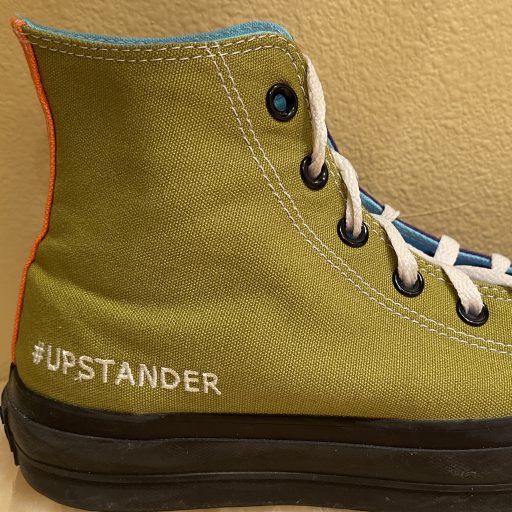
When asked what I do for a living, I will often respond “I make Upstanders.” Not what most people expect for an answer and usually results in a few questions – “what is an Upstander?” and “how do you know?” being most common. I define an Upstander as one who takes action when they see an injustice – who does not stand by and watch others bully, oppress or persecute people, but rather steps in to do something about it – or better, work to prevent it in the first place. I have stories of amazing things my former students have done since leaving my classroom and this anecdotal evidence is impressive, but does not convince those looking for a more evidence based response. I have been privileged to be part of the Mandel Teacher Educator Institute for the past two years and as part of this fellowship was able to do a graduate certificate at HUC in Practitioner Research. The work of this certificate has been researching my own practice as a teacher and my research question came to me quickly – Do I make upstanders or not? And if so, what are the experiences in my classroom that most impact this development?

A Google survey completed by 32 JDS alumni from 2011 – 2025 and six interviews later,  the answer is a resounding yes – that the coursework in my classroom, as well as other classes at JDS – does instill in young people a clear understanding of the importance of being an upstander – and now I have 32 definitions of this word and not just my own –  as part of my research I had the respondents write their own definitions for the word “Upstander.” This information was very informative and provided a window into how each of these young people thought about being an upstander. Respondents also had an opportunity to respond with details about their learning in Jewish Studies as well as their General Studies classes and these free responses were also very helpful in getting a full picture of what the formative lessons were during their years at JDS and just what went into making an upstander. 

As I coded these responses I began to compile a list of the “habits and practices of an Upstander” on a giant post-it note on my wall. I then sorted these into different categories – skills, values, character traits, practices and actions. This work helped me create a graphic that shows the development of a JDS upstander. 

I would like to use the traits and the actions of an Upstander – as determined by my research – to discuss these two stories of Abraham and think about what might have helped Abraham in Genesis 22 be more like the Abraham of Genesis 18. 

The traits that were named by my former students as essential to being an Upstander are: brave, a leader, questioning, confident, positive, action oriented, grateful, joyous, reflective, and possessing a growth mindset. 

Abraham facing God as he is given insight into God’s plans for the home of his nephew Lot and the neighboring town is seen as a leader by God. God shares his plans with Abe because God plans to make Abraham the father of a great nation by whom all the nations of the world will bless themselves. Abraham takes the time allowed by the other two visitors to leave to consider what God has said. He then acts bravely and asks a question of God – “Will you sweep away the innocent along with the guilty?” He is confident that God could not mean to punish the innocent and puts forth a positive vision of saving the city for the sake of the innocent. He challenges God “Shall not the judge of all the earth deal justly?” 

Civil discourse is an action that upstanders use and Abraham is trying to have a civil discussion with God, Abraham is giving a voice to the voiceless – he is speaking for the innocents of Sodom and Gomorrah who stand to be wiped off the earth for the sins of their neighbors and he is advocating for change in God’s plan. Abraham is considering all the residents with dignity and he is standing up for what is right. All of these are actions named as those of Upstanders by JDS graduates.  Abraham continues to question God – being willing to accept that there  might not be 50, 40, 30, even 20 innocents in these towns – and lowers the bar with each increasingly meek request. His bravery in continuing to lower the number with each request and to continue to press God to do the right thing is impressive. Who among us can imagine making such requests of a human leader let alone God!? Abraham reflects on each request, on God’s agreement and is grateful for this agreement – but also knows that the number might need to be lower. His reminding of God that God is the judge of all and should be just reminds God of God’s role and to educate God about what God’s actions look like to the leader he has chosen. He is mindful of the terrible fate awaiting those in Sodom and Gomorrah and acts in a way informed by this perspective.

Abraham in this story also demonstrates many of the skills of an Upstander as found in my coding of my data. He is advocating and using his public speaking skills to confront God. He is thinking critically about what might be acceptable to God – he stops at 10 perhaps sensing God was not willing to go lower. He is making connections for God – reminding God of how God’s actions have lasting consequences and lessons for humans. Values of an Upstander include compassion, empathy, justice, morality, community, respect and gratitude – Abraham demonstrates all of these in his interactions with God in chapter 18. His compassion for those in Sodom and Gomorrah – empathy perhaps for his nephew and his family, his demanding God be just and act morally are clear as are his sense of community with these people. He speaks to God, even as he challenges him, with respect and expresses gratitude when God agrees to each request. 


Abraham in this story is a patriarch worth emulating. He is being a role model – a practice of Upstanders – and showing how to stand up to unjust power and to demand that even God acts with morality. He does not go along with God’s plan, he does not just request God spares Lot and his family, he advocates for all the innocents of Sodom and Gomorrah and pushes God to find a reason to not destroy these communities. So what happens between here and the story of Akedat Yitzhak – the binding of Isaac just four short chapters later? 

In Chapter 22 God speaks to Abraham and Abraham responds with that word of destiny “Hineini” “Here I am.” This word indicates an openness to what follows and a willingness to be commanded or used for God’s purpose. God then proceeds to command Abraham to take his son “your favored one, Isaac” and to go to Moriah and offer him up as an “oleh” burnt offering on one of the heights there that God will point out later. Now, prior to calling out to Abraham we are told that GOd is putting Abraham to the test. Abe does not know this and I feel that we are left to determine if he passes it or not. I would say that he does not – he certainly fails at being an upstander. Being commanded to offer up your son – a son of your old age that was born after a promise from God that you would finally have a son with your elderly wife, the only son you have now because you already sent the other one away because your wife asked you to – is not a command that anyone should follow unquestioningly – but Abraham does. That questioning and confident leader who was brave and stood up to God is gone. There is no discourse – civil or otherwise – as Abraham silently gets up and starts preparing for the journey. Abraham does not show any compassion or empathy for his wife, whose only son is about to be killed, there is no evidence he even tells her where he is going and midrash says her death in the next parsha is due to her finding out from HaSatan where father and son have gone. There is no reflection on the justice or morality of this request. A wondering when we started doing child sacrifices might have been voiced. 


Abraham is action oriented as he gets up early, packs a donkey, and heads off with his son and some servants. Again there is no discussion, only a few words are recorded on day three and those are vague and either hopeful or lies. “God will provide for the sheep” is the response to Isaac wondering where the offering is. In the end, God does indeed provide the ram for the sacrifice and it is God, or the angel, who gives voice to stop Abraham’s blind obedience to God’s command. 


Abraham’s lack of curiosity or demand for justice continues when God declares that “For now I know that you fear God, since you have not withheld your son, your favored son, from Me.” I would have been furious. God needed this proof? Abraham has gone through so much at the command of God and has proven his faithfulness over and over. I would have demanded to know why God needed even more proof – and proof gained in such a cruel and unjust manner. I would have asked God about the damage done to my son, the sorrow caused for my wife, my own trauma and guilt at being willing to do this just so God – the all knowing God – could be sure of my faithfulness.  We get none of this from Abraham. In one of my favorite Rosh HaShanah books – The White Ram – which I read each year to my middle schoolers – Abraham does question why God needed Abraham to prove his love and faith since God knows all. God responds “Oh, I knew, but I wanted to be sure everyone else knows so that would follow your example.” Follow his example?? This is hardly an Abraham whose example we should follow. Back in the text in the Torah, God makes Abraham some more nice promises and then Abe returns to his servants and heads to Beer-sheba. Next we know Sarah is dead and Isaac never speaks to his father again. Abraham’s days as a role model are over. 

My research, and that of other researchers who have set out to figure out what it takes to “create Upstanders” shows that an inspiring role model has an incredible impact on helping young people know that they should take action. In my findings I name this as “The Power of One Significant Story.” In my classroom these role models are Jewish Partisans, RIghteous among the Nations, individuals who show moral courage and create change in the world or save lives, Rabbi Avraham Joshua Heschel who marched in Selma, Jan Karski, Hebrew prophets who spoke out against corruption at the highest levels and others throughout our history who stood up and led rather than allowing history to happen to them. Abraham in Genesis 18 would be a Significant Story. Abraham in chapter 22 would not. Jewish values of v’ahavta re’echa k’mocha – treat your fellow as yourself – the core text of Judaism which teaches love and empathy – as well as “lo taamod al dam re’echa” “do not stand on the blood of your fellow” which means that we should prevent blood from being spilled and act to protect those who are likely to be harmed – are taught in sixth grade in my classroom to provide a values based framework for why it is important to be an upstander. Chapter 18 Abraham demonstrates these values – he is actively working to stop the bloodshed of innocents in Sodom and Gomorrah – Akedat Yitzhak has Abraham ready to spill the blood of his own son. 

Remaining engaged and capable – let alone willing – to be an upstander can be exhausting. I know this is very true in our current reality. Compassion fatigue is very real and there is so much going on that we would like to fix, but which we are powerless to really impact. So how does one remain mindful and engaged? The three traits of an Upstander as named by my former students that were most surprising were joyous, grateful and positive – add to this the practice of mindfulness which several of those interviewed gave much credit to for their commitment to doing good in the world. Gratitude for what we have creates a capacity for wanting others to have the same things and reminds us that our work for their rights and well being isn’t leaving us without. Being joyous also gives energy and creates the positivity needed to face situations that feel overwhelming or frightening in order to help others. Mindfulness as a daily practice allows these young people to be aware of what is going on in their worlds and to stay in a mindset that is open to what others are experiencing. It allows them to not be overwhelmed by all that is going on and therefore have more capacity to help. One of my former students, let’s call him Solomon, said that daily mindfulness sessions help him to focus on being his truest self “Solomon Solomon”  and his truest self is an Upstander. “Solomon Solomon loves all people and cares and is trying to be empathetic and the best, most righteous Jewish version of myself would be to stand up for the inequities that I see in the world. They also help him monitor his energy and that it is being spent in productive ways that allow him to make an impact. “And not just that upstanding is exhausting. So when are the right times to upstand and what are the times to pick your battles and say today’s not that day?”


One might surmise that being Abraham in his old age, having sent away Hagar and Ishmael, pressured to create a people who will worship God and be a great nation when you have only one son to start with, might have been a lot to deal with. Perhaps Abraham no longer had the joy, positivity and gratitude necessary to have the capacity to stand up to God again. Perhaps his failure to save Sodom and Gomorrah weighed on him and made him less likely to make demands of God? Following the commands of God, who had given him all that he had, might have been how he thought he was to show gratitude – rather than by acting according to the values that God sought to instill in him. To know God should be fair and just in chapter 18 but not demand it in 22 when your own son’s life is at stake, indicates a serious shift in energy and mindset. How might Abraham have been better able to be an upstander for Isaac?  How do any of us find the energy to push back against all that is wrong in the world? 

Community, gratitude, mindfulness, seeing failure as a stepping stone to success, and having the perspective of history can help us to know what is important and to continue to find the energy to defend it. Finding role models who inspire us, being a role model for others can also give us energy and ideas. Remembering the core values of our traditions as well as the universal values of empathy and compassion keeps us centered. Remembering that all humans are made b’tzelem elohim – in the image of God and are worthy of the same dignity and respect will guide us in our choices and actions. Let us not be like Abraham and sacrifice what is most important to us because we have lost our abilities to be upstanders – let us lean into community, joy and gratitude and remain strong. 

Don’t be Jonah

Standard

Darshan Jonah

Yom Kippur 5784

Nance Morris Adler

(I was honored to give the sermon on the Book of Jonah at my shul this Yom Kippur. This is my teaching. I dedicated it to my students who are always my teachers.)

In 6th grade Jewmanities – that is what I call my classes at JDS as I teach a combination of Jewish text and social studies – so like Humanities but with a very Jewish lens – I teach a unit called “There is No Profit – PROFIT – in Prophecy.” In this unit my students learn about the 10 parts of a classical book of prophecy in the Jewish tradition, as well as about the life of a prophet. They then choose a modern problem and must write their own book of prophecy where they are called by God to solve this problem. The students love this unit and have written some amazing stories over the years.

So you can imagine, having taught this unit for 12 years now, that I am VERY familiar with how a Hebrew prophet is meant to behave and what a book of prophecy usually contains. I can list the 10 common parts and cite examples from across the major and minor prophets to show what they look like. So, despite having a list of ideas of what to talk about today that covers multiple notebook pages and is inspired by the great darshanim who have gone before me, I am ending up having the most to say about how Jonah – and the Book of Jonah – do not fit this mold and to offer up a few ideas as to perhaps why this is and what we can learn from it. If I am really lucky, I will manage to work most of those other ideas in as well. 

First I want to set Jonah in time and place as that information will be important in much that I have to say about why Jonah and the Book of Jonah are different. Yonah Ben Ammitai is mentioned in 2 Kings 14:25 – this would place a historical individual named Jonah during the reign of Jeroboam II in the mid 8th century BCE. Based on the language used and particulars of the story however, most scholars place the book in the post-exilic period around the late 5th or 4th century BCE. Jonah lives in a post-exilic world – a world where both he and those with whom he interacts – from the sailors to the Ninevites – know that God will carry out God’s threats of destruction and exile – and this is important to both his actions and his success. 

So. Back to the parts of a book of prophecy. The first part – really the first three parts – are about God calling the prophet. While this is the first part, it does not always happen first. God will let the chosen individual know that they have been selected to be God’s voice to the Israelites. This can be done subtly or with great fanfare like Ezekiel’s vision of God’s merkavah – throne/chariot – and the Hayiot HaKodesh. After the call, the newly selected prophet will protest, say no, make excuses. Isaiah’s call comes in chapter 6 and he responds by saying “Woe is me! I am undone because I am a man of unclean lips, and I dwell in the midst of a people with unclean lips…” God then demonstrates a prescient knowledge of germ theory and basically autoclaves Isaiah’s unclean lips by sending an angel with a hot coal to make them clean “Behold this has touched your lips and your iniquity is taken away and your sin is purged.” Now, if this story of a coal and lips doesn’t bring you right to Moses, your blood sugar might be falling this late in the day on Yom Kippur. Moses is the master of the refusal. When God speaks to Moses out of the burning bush and tells him to return to Egypt and “let my people go,” Moses says no FIVE times. God gives long speeches after each reason to reassure Moses and to provide evidence – a rod that does miracles – specific instructions – God gives Godself a new name even – but Moses continues to say no. He blames being “thick of tongue” and says he won’t be a good spokesperson. Midrash comes in to explain that he burnt his tongue on a coal during a test by Pharaoh’s magicians as a baby. One coal makes you holy, another gives you a lisp. God at this point gets angry and says Aharon is coming and he is a good public speaker and for Moses to get moving back to Egypt and meet him. 

So, Jonah is clearly called by God – no big show but a clear directive. Jonah makes clear that he has no intention to obey, but does not tell God why and allow God to placate his worries or address his concerns. He hightails it out of town towards Tarshish. Jonah clearly forgot about that “all seeing” aspect of God and thought he could slip out of town unnoticed. Not so. God knows where Jonah is and sends a terrible storm. 

I want to pause here and talk about what Jonah’s concerns might have been. Why did he not want to go to Nineveh? We know how the story ends and Jonah is the only “successful” prophet in that he gets the people of Nineveh to repent and God does not have to punish them. Jonah delivers a pared down message – none of the metaphorical language, parables, symbolic acts, eschatological visions or other things that are parts of a classical book of prophecy. But yet the people listen and change their ways. God’s judgment is stayed – or the punishment is stayed as the judgment is for good. Which is what we are all here praying for today – for our changes and attempts to be better to be seen and to be good enough to earn us another chance to continue to better ourselves. 

So why did Jonah want nothing to do with this mission? Why was he willing to flee an all seeing God? Why was he willing to be thrown overboard to save the innocent sailors but not willing to go to Nineveh and give a little prophecy? 

There are a variety of theories put forth over the centuries by rabbis and commentators as to why Jonah wanted nothing to do with this assignment. Some say Jonah knew that the people would repent and that God would not punish them – some say this meant that Jonah was worried he would look like a false prophet – others say that Jonah worried it would make God look weak or imaginary since nothing would happen. Still others say that Jonah wanted God to act with pure “din” judgment but knew that God would actually act with a combination of din and hesed and therefore no punishment would occur. The episode at the end of the book – with the plant – is God showing that same hesed – lovingkindness – to Jonah in an attempt for him to see the importance of this quality of God. Nothing happening in Nineveh would “prove” Jonah was successful but can we learn from the absence of something? People have a hard enough time learning from actual historical events or current events, let alone from “nothing” happening. Today when something is predicted and then doesn’t happen, many assume that the original prediction was wrong, rather than that conditions changed or the event was avoided. This would be in line with one of the reasons given for Jonah’s refusal. Would others say “Wow! God was going to destroy that place but they all repented – even the donkeys – so I better repent of my evil ways as well so God doesn’t destroy me.” Or would they say “That Jonah Ben Ammitai is full of hot air. He is one of the false prophets we have been warned about.” Jonah’s actions indicate he was concerned it would be the latter. 

One of the difficulties of the job of a Hebrew Prophet is that they work both for God and for the Jewish People. They are delivering God’s message but they also really want the people to change and avoid God’s wrath. They try to temper God’s anger and delay God’s judgment. They argue and wrestle with God. They spin beautiful metaphorical passages to explain the feeling of betrayal and paint a picture of what could be. They live a life caught between God and the people and suffer terribly for it. They are abused – Jeremiah in particular suffers terribly – they are abandoned by family and friends. Many seem to have mental health issues, depression. But they work for the Jewish people – THEIR people. God sends Jonah to speak to the Ninevites. These are NOT his people. Does Jonah really care about them or whether they hear his message? Even after he emerges from the Dag Gadol – big fish – and heads to Nineveh, he really puts minimal effort into his work. No flourishes of metaphor. No parables. No visions of a perfect world once they mend their ways. No elaborate symbolic acts to reach those who need a visual rather than a verbal message. Nope. A bare bones “Forty days more and Nineveh will be overthrown!” But yet the people immediately “believed God” and proclaim a fast and put on sackcloth. The King sits in ashes and declares a fast for all including the “flock and herd.” He commands all to “turn back from his evil ways and from the injustice of which he is guilty” so that God might not punish them. 

The response of the King of Nineveh could not be more different from that of Israelite kings to the prophets who came before them. Sure Jeremiah is rescued from the pit but he is sworn to secrecy about the king’s help in that. The entry in the Jewish Encylopedia states that the behavior of the King of Nineveh clearly puts the Book of Jonah into the category of midrash and myth as this would never happen. But it makes me wonder about the timing of the Book of Jonah and it being post-exilic. If the king knew what had happened to the Kingdoms of Judah and Israel – the Southern Kingdom and the Northern as well – and if he saw the human historical events as being allowed by God as Jewish tradition frames them – then he would know that God was capable of destroying Nineveh. He would know that God’s patience had limits. He might wonder if those limits were shorter for those who were not God’s chosen people. This knowing the lessons of history – something near and dear to my heart as a Holocaust educator – and ACTUALLY learning from them to save his own people might be AS mythological as the Jewish Encyclopedia article writer believed his responding to a Hebrew prophet was. I see the role of the King of Nineveh as a strong leader, with the wellbeing of his people clearly primary in his motivations as key to the success of Jonah’s work. The king walks the walk. He repents and models what that looks like for his people. Sure he is saving his kingdom as well, but lowering himself in order to do that is not a forgone conclusion. Many rulers, hyped up on their own power and reputation, would have ordered others to wear sackcloth and ashes but ordered theirs from the Biblical equivalent of Neiman Marcus. 

While Jonah doesn’t use parables and metaphors, there are within the story many elements that can be seen as metaphoric. Jonah’s time in the DagGadol – big fish – is one such element. Jonah wants judgment – he wants the people to have to fully fix everything they are doing wrong or suffer. He knows God will look away from the small missed marks if they fix the big ones. He does not value compassion. While the book is written in a post-exilic world, Jonah – either the historical Jonah ben Ammitai who lived pre-exile, or Jonah of the post-exilic book – did not live through exile. He did not suffer defeat and forced expulsion from his homeland. Jonah does not see value in empathy and lovingkindness. If he was going to go to Nineveh he expected God to be fully focused on “din” but he knew that God would not be. God provides Jonah with an experience of exile in the belly of the big fish. Jonah is cut off from all he knows. He is in a strange place and in fear for his life. While teaching Jonah this past week, I asked my sixth graders to imagine being alone in a place like the belly of a giant fish and what would they be thinking. After several described how they would try to make the fish throw them up – missing the “thinking” part of my question – one finally put it perfectly “I would miss society and all that I knew.” On the third day Jonah is moved to prayer “I thought I was driven away out of Your sight. Would I ever gaze again upon Your Holy Temple?” Jonah realizes that his actions are “folly” “Those who cling to empty folly forsake their own welfare. But I, with loud thanksgiving will sacrifice to You; what I have vowed I will perform. Deliverance is the Lord’s.” God has Jonah spewed out on dry land and he proceeds to Nineveh. This experience of being isolated and feeling rejected by God allows Jonah to feel enough compassion to get him to Nineveh and deliver God’s message. I can imagine that Jonah knew that God could have dealt much harsher with him for trying to escape the job of being a prophet – a job all of the other major and minor prophets make clear is not one that can ultimately be refused or escaped. I would think God would have been extra angry at the insult of Jonah thinking he could escape an all knowing deity. This knowledge – that he had been shown both din and hesed – would, we hope, make Jonah value both attributes and be glad that God displays both when acting in the world. But, sadly, his response to Nineveh avoiding destruction shows that he has not fully learned this lesson. 

Here on Yom Kippur the bigger question is do we learn the lesson? Do we allow the times in our lives when we have needed compassion and mercy to teach us that we must then extend these qualities to others? I have spoken in the past about Judaism – religion in general – needing to be about love. R. David Hartmann says that the core of Judaism is love and all understanding of God and Jewish law needs to center on that knowledge. We need love – from other humans and from ourselves – and we need to remember the core teaching of Judaism – to treat others as we want to be treated – or “do not do to others that which is distasteful/abhorrent to you.” Jonah enjoyed God’s mercy when he was spit out of the big fish and allowed to live and he also enjoyed the shade of the plant that God provided to shelter him from the heat. Despite this, Jonah was angry that God showed similar mercy to an entire city state by sparing Nineveh. He is angry when his plant dies, but has no similar compassion for “Nineveh, that great city, in which there are more than a hundred and twenty thousand persons who do not yet know their right hand from their left, and many beasts as well.” 

In many issues today we see those who benefit from compassion and mercy in our society but who do not extend the same to others. Those whose family came here as immigrants who do not wish to allow others fleeing persecution to be given entrance. Those who enjoy rights that they would deny others. Those who benefit from social networks they would deny others. Those who request support and services but deny the same to similarly needy individuals. Some don’t even extend compassion to themselves and vote and advocate against their own needs. Those who want to make all the choices about their lives, but deny that basic human right to others. These individuals would be angry at God for sparing Nineveh but expect shade and grace extended for them. They do not want to hear Jonah, and those whom they follow do not know how to model humility and change for the better of all. 

The Book of Jonah is here to make us stop and consider our behavior and our ability to learn and grow. Judaism provides us with a yearly opportunity – a yearly requirement really – an oblitunity if you will – to review our behavior and resolve to do better in the future. We are all human and we all act in ways that are not always full of love. We are influenced by our experiences, by our education, the news, social media, friends and family. Our job is to hear the terse and unpoetic warning of Jonah and repent of our misdeeds. Jonah is not a typical Hebrew prophet trying to change the ways of a stiffnecked people bent on pissing off God by repeatedly breaking the terms of our b’rit – our covenant. Those prophets don’t want their jobs because they know they are not going to be successful and are going to be hated. They are speaking to a familiar people and they know what to expect. They are one of those stiffnecked people and know that permanent change has not happened since Moses led them out of Egypt and isn’t going to happen now. Jonah is speaking to a different people. Jonah’s audience is open to his warning – they want to avoid destruction. They have strong leadership that is open to change and models what that looks like. Humility and compassion are needed qualities in our world – Empathy and continued growth as well. Not just in leaders, but for all of us. The lesson of Jonah is to not be Jonah – but to “walk in God’s ways” and show empathy and compassion – to temper justice with mercy, and to remember that we are all humans – flawed but capable of positive change and learning to work for the betterment of all. May we all be sealed for a good year – a year of compassion, mercy, peace, love and growth – because of our dedication to Teshuvah and Tikkun – repentance and repair.